


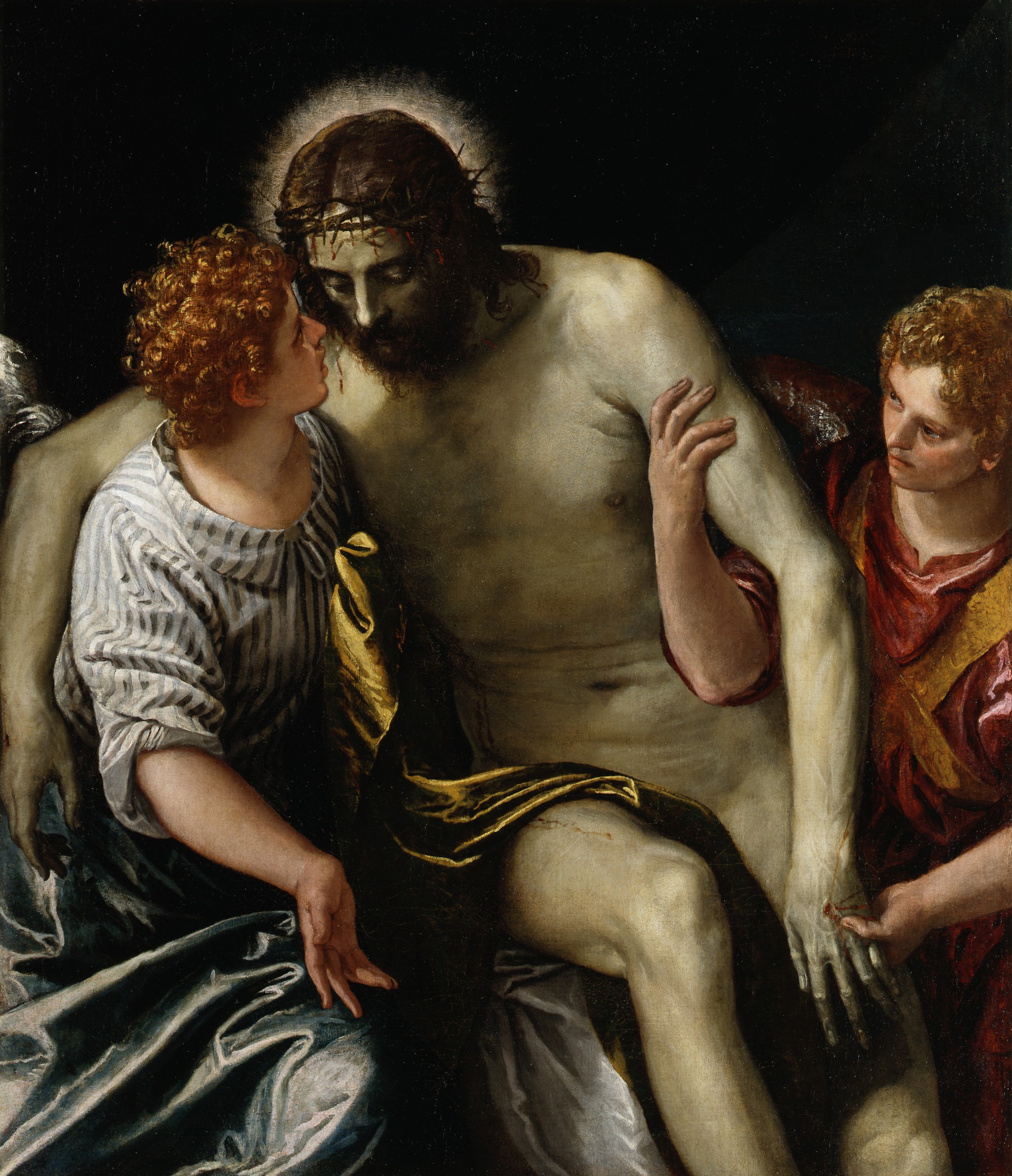
Der tote Christus, von zwei trauernden Engeln gestützt


Fotonachweis: Staatliche Museen zu Berlin, Gemäldegalerie / Jörg P. Anders Public Domain Mark 1.0

Objektbeschreibung
Der Bildtypus der Engelpietà entstand um 1400 in Frankreich. In Venedig hat Giovanni Bellini das Thema mehrfach dargestellt und zum selbständigen Andachtsbild weiterentwickelt. Ein Beispiel von 1480/85 befindet sich in Berlin. Etwa 100 Jahre später datiert Veroneses Darstellung. Der grünlich-graue Körper des toten Christus steht im krassen Gegensatz zu den rosig-gesunden Fleischtönen der blondlockigen Engel. Der Linke zeigt Christi Hand mit dem Wundmal vor. Christus ist tot und dennoch scheint es, als spräche der zweite Engel mit ihm, ganz nah ist sein Kopf am Gesicht des Toten, seine Hand weist im Redegestus in Richtung Betrachter. Und tatsächlich: Mund und Augen Christi sind geöffnet. Der betonte Sensualismus der Darstellung, die Körperlichkeit des Toten (man beachte Muskeln und Adern seiner Arme), unterstützt von der Farbigkeit und dem Helldunkel, zielt auf das Mitempfinden des Betrachters und weist auf Prinzipien der Barockmalerei voraus.| Prestel-Museumsführer - Gemäldegalerie Berlin, 2017
_____________________________________________________
The pictorial type featuring a Pietà with angels emerged in France around 1400. In Venice, Giovanni Bellini depicted the subject several times and developed it further as an independent devotional picture. There is an example dating from 1480/85 in the Gemäldegalerie. Veronese’s version dates from about 100 years later. The greenish-grey body of the dead Christ stands in stark contrast with the angels’ fair curls. The angel on the left is showing Christ’s hand with the stigmata. Christ is dead, yet it seems as though the second angel is speaking to him; his head is very close to that of the dead Christ, and his hand is pointing to the viewer in a gesture that suggests speaking. Indeed, Christ’s mouth and eyes are open. The marked sensuality of this portrayal, the dead Christ’s physicality (note the veins and muscles in his arms), supported by the colour and the chiaroscuro, are all aimed to attract the viewer’s sympathy and anticipate principles of Baroque painting.| Prestel Museum Guides - Gemäldegalerie Berlin, 2017