


Deukalion und Pyrrha


Fotonachweis: Staatliche Museen zu Berlin, Gemäldegalerie / Jörg P. Anders Public Domain Mark 1.0

Objektbeschreibung
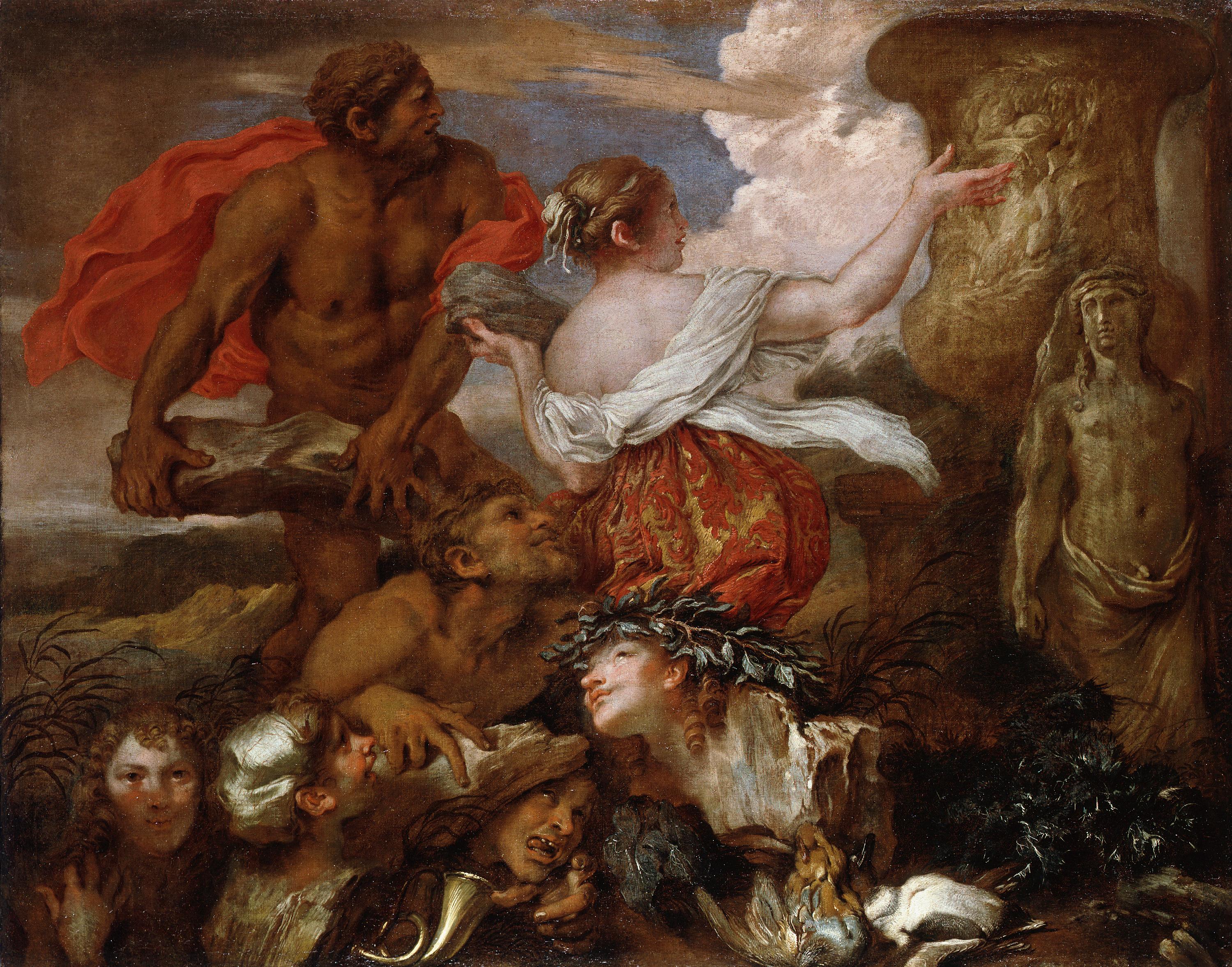
Die 1655 datierte, von einem Protagonisten der Barockzeit in Genua und Rom ausgeführte Darstellung basiert auf den Metamorphosen Ovids (I, 125-415). Das Ehepaar Deukalion und Pyrrha trägt große Steine (laut Orakel: die „Gebeine der Mutter“, also der Erde), die nach dem Opfer an Zeus auf Geheiß des Orakels rückwärts zu werfen wären. Nur so, als einzige überlebende Menschen nach der großen Flut konnte aus den Steinen das Menschengeschlecht wieder ins Leben gerufen werden. Neue Menschen sind im Vordergrund als bizarre Ensemble unterschiedlicher Köpfe dargestellt. Offen bleibt die Bedeutung des mit herausgestreckter Zunge unter einem Felsenblock eingeklemmten Gesichts und der obenliegenden lorbeerbekränzten Muse. Trotz der lebendigen neo-venezianischen Farbigkeit ähnelt die Komposition sehr der Modellierung eines Basreliefs. Zudem erinnert die hemmungslose Energie an Gian Lorenzo Bernini.
____________________________________________
Dated 1655 and executed by a protagonist of the Baroque period in Genoa and Rome, it is based on the Metamorphoses of Ovid (I, 125-415). The couple Deucalion and Pyrrha carry large stones (according to the oracle: the "bones of the mother", i.e. the earth), which after the sacrifice to Zeus would have to be thrown backwards at the command of the oracle. Only in this way, as the only surviving humans after the great flood, the human race could be brought back to life from the stones. New humans are represented in the foreground as a bizarre ensemble of different heads. The meaning of the face wedged under a boulder with its tongue out and the laurel-wreathed muse above remains open. Despite the vivid neo-Venetian color scheme, the composition closely resembles the modeling of a bas-relief. Moreover, the unrestrained energy is reminiscent of Gian Lorenzo Bernini.