


13 Ergebnisse
Objekttyp: Relief im Rahmen


Kreuzabnahme
Skulpturensammlung und Museum für Byzantinische Kunst
Eine Zeichnung der Kreuzabnahme von Michelangelo im Teylers Museum in Haarlem, in der die zentrale Szene um die Christusgestalt in ganz ähnlicher Weise gestaltet ist, wird als Vorbild für das Berliner Relief angesehen. Die Komposition fand im 16. und 17. Jahrhundert außer in Bronze auch in Wachs, Elfenbein und Silber Verbreitung. Die Veränderungen gegenüber der Zeichnung und die Art und Weise dieser Umsetzung der ›invenzione‹ Michelangelos in das plastische Medium lassen sich auf dessen Schüler Daniele da Volterra zurückführen. In seinen Gemälden orientiert sich dieser nicht selten direkt an den Vorbildern seines Meisters.


Ecce Homo
Skulpturensammlung und Museum für Byzantinische Kunst
Die Bronzetafel zeigt den Gottessohn als Schmerzensmann, nach der Kreuzigung seine Wundmale vorweisend, zusammen mit zwei Engeln, welche die Leidenswerkzeuge: die Lanze, den Stab mit dem Essigschwamm und die geißeln halten. Die Figuren stehen fast freiplastisch auf einer schmalen, durchgehenden Konsole, die wie ein geschnitztes Maßwerk ornamental durchbrochen ist. Hinter der Figur des Erlösers ragt ein Kreuz auf, das auf einem Schriftband die von Pilatus veranlasste lateinische Inschrift INRI, die Abkürzung für ‚Jesus aus Nazareth, König der Juden’, trägt. Typologisch ist das Relief ungewöhnlich, denn üblicherweise werden die Engel mit den Leidenswerkzeugen in der Szene der Kreuzabnahme dargestellt, wo sie den Leichnam stützen.

Taufe Christi im Jordan
Skulpturensammlung und Museum für Byzantinische Kunst
Das Relief in Gestalt eines halben Bogenfeldes stammt vom 1515 in Auftrag gegebenen Hochaltarretabel der Johanneskirche in Moosburg, das 1683 entfernt und durch einen neuen Altaraufsatz ersetzt worden war. Es war oben auf der Innenseite des linken Flügels angebracht. Auf gleicher Höhe befand sich am rechten Flügel die im Diözesan-Museum von Freising erhaltene Darstellung der Taufe von Johannes dem Täufer in der Wüste. Wie im Fall der sitzenden Figur Christi im Elend (Inv. Nr. 8347) begegnet man in der Darstellung der Taufe im Jordan einer Christusgestalt von athletischem Körperbau. Vermutlich ist Leinberger, der zu den erfindungsreichsten Bildhauern Süddeutschlands zählt, mit italienischer Renaissancekunst in Berührung gelangt. Darauf scheint auch die hier zu beobachtende Reliefauffassung, der durch eine atmosphärisch gebildete Wolkenwand abgeschlossene, einheitliche Bildraum hinzudeuten.
Maria mit Kind in einer Nische / Virgin and Child in a Niche
Skulpturensammlung und Museum für Byzantinische Kunst
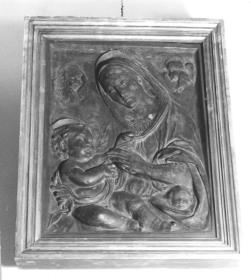
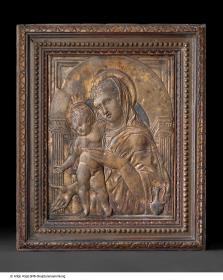
After Donatello Donato di Niccolò di Betto Bardi Florence ca. 1386-1466 Virgin and Child in a Niche Bronze, with traces of silver 20,3 x 15,3 cm Berlin, Staatliche Museen, Skulpturensammlung, Inv. SKS 3044. Bode-Museum, on view. Provenance Berlin, Hainauer Collection (before 1906); Berlin, Skulpturensammlung/Kaiser-Friedrich-Museum (1906-1939); Berlin, storage (1939-1945); Merkers, storage (1945); Wiesbaden, Central Collecting Point (1945-1956); West Berlin, Skulpturensammlung/Museum Dahlem (1956-1990); Berlin, Skulpturensammlung/Museum Dahlem (1990-1997); Berlin, storage (1997-2006); Berlin, Skulpturensammlung/Bode-Museum (since 2006). Acquisition Gift of Henry Duveen, Duveen Brothers, London, 1906; as by Donatello. Acquisition file n°F. 1395/06 (untraced). Other versions • Berlin, Staatliche Museen, Skulpturensammlung, Inv. SKS 76. Painted stucco. • Budapest, Szépmüvészeti Múzeum, Inv. No. 2049: Stucco, 69 x 32 cm. • Florence, via del Corso. • Florence, via Ghibellina. • London, The Wallace Collection. Inv. S 297. Bronze, 20.3 x 15.3 cm. • London, Victoria and Albert Museum, Inv. 7385-1861. Stucco, 47,5 x 32,5 cm; 20 x 15,5 cm without frame. • Orbignano (Pistoia), Santa Maria. Marble. • Paris, Musée du Louvre, Inv. 704. Terracotta, 21.8 x 16.9 cm. • Ravenna. Marble. • Sinalunga, SM delle Nevi. • Vatican State, Museo Sacro. Marble (KIF 171507). • Washington DC, National Gallery of Art, Kress Collection, Inv. 1957.14.131. Bronz ( Formerly Paris, Gustave Dreyfus collecti.) • Formerly Amsterdam, private collection. • Formerly Florence, Grassi collection. Bronze (Photo Kunsthistorisches Institut Florenz n°59966). • Formerly London, Christie’s, sale 7th July 1987, lot 150. • Formerly New York, sale of the Raoul Tolentino collection, 1926, lot. 719. Stucco. Curatorial Files in the Bode-Museum Letter from Ulrich Middeldorf to Peter Metz, 9 January 1961: discusses the rediscovered version in Orbignano. Comment This bronze relief of the Virgin and Child is known in several other versions, the closest two to the present one being in the National Gallery of Art, Washington DC and in the Wallace Collection, London. The Virgin holds her standing Child with her left hand, while gesturing invitingly toward the viewer with the other – a gesture echoed by the right hand of Christ, who holds onto the neck of his mother with his other hand, in a realistic depiction of trying to maintain balance. Both figures are seen behind a balustrade on which the Child is standing, and a vase is displayed; they stand out from a niche seen in perspective, which appears to be at some distance behind them. It is not a coincidence that the name of Donatello has always been mentioned when discussing this typology of the Madonna and Child: the pose of the Madonna with the left arm parallel to the picture plane recalls another plaquette with a Donatellesque attribution (see Inv. SKS 1028), while the open right hand is a motif used in the High Altar of the Santo in Padua. The anatomy of the Child is typical of Donatello, as is the way his left arm is hidden behind his mother’s head, with only the tips of the fingers discernable (see Inv. SKS 1940). The architecture of the niche, seen in perspective and with reference to Antique forms that are now in ruins, is present in many works by the artist, such as the bronze relief of the Feast of Herod made for the Baptistery Font in the Cathedral of Siena. Rather than Donatello himself, whose direct style cannot be recognized in any version of the series, the critics have generally and convincingly seen the relief as by an artist from his school, probably after a model by the master (Bode 1897; Schubring 1907b). In 1961, a Madonna relief in marble was found in Santa Maria, Orbignano and attributed to Donatello by the local press (N. V. 1961); however, this relief is too weak to be by Donatello and is certainly by Urbano da Cortona instead, who authored the reliefs from the Chapel of the Madonna delle Grazie in Siena Cathederal, now in the Museo dell’opera metropolitana, Siena. The composition was reproduced in a drawing by the school of Pisanello preserved in the Musée Condé, Chantilly (the absence of a vase having made Jolly 1998 think that is was missing from the original composition, which is far from convincing). Christiansen 2004 related the work to Florentine painters such as Paolo Uccello and the Master of Pratovecchio; the echoes of such a composition are also especially important with artists in the region of Padua, such as Giorgio Schiavone (National Gallery, London); Marco Zoppo (British Museum, London, Inv. 1920-2-14-2); Niccolò Baroncelli (the Miracle of St Gilles, Museo Civico, Padua; see Galli 2010); or Andrea Mantegna (see Edskerdjian 1992). It is conceivable that the prototype for this work was made by Donatello between Padua and Florence, i.e. during the 1440s. Literature Molinier 1886 Émile Molinier, Les Bronzes de la Renaissance. Les plaquettes. Catalogue raisonné, Paris, Jules Rouam, 1886, I, p. 34 cat. 64: Donatello, mentions the bronze version in the G. Dreyfus collection now in the National Gallery of Art, Washington DC, and the variant in terracotta in the Musée du Louvre. Bode 1897 Wilhelm Bode, Die Sammlung Oscar Hainauer, Berlin, W. Büxenstein, 1897, pp. 29, 80 cat. 127: school of Donatello. Schubring 1907a Paul Schubring, Donatello. Des Meisters Werke in 277 Abbildungen, Stuttgart and Leipzig, Deutsche Verlags-Anstalt, 1907, pp. 170, 201: circle of Donatello. Schubring 1907b Paul Schubring, “Gli acquisti del museo ‘Kaiser Friedrich’”, L’Arte, X, 1907, p. 452: not Donatello, but a pupil. Bange 1922 E. F. Bange, Die Italienischen Bronzen der Renaissance und des Barock, Zweiter Teil: Reliefs und Plaketten, Berlin and Leipzig, Walter de Gruyter, 1922, p. 1 cat. 3: Donatello. Kauffmann 1935 Hans Kauffmann, Donatello. Eine Einführung in sein Bilden und Denken, Berlin, Grotesche Verlagsbuchandlung, 1935, pp. 156, 223. Landais 1958 Hubert Landais, Les bronzes italiens de la Renaissance, Paris, Presses universitaires de France, 1958, p. 33: close to Donatello; same artist as the bronze Flagellation in Berlin (Inv. SKS 1027); the Camondo Crucufixion in the Musée du Louvre, Paris; and the St Sebastian in the Musée Jacquemart-André, Paris. N. V. 1961 N. V., La Nazione, 19 juin 1961, p. 5: original version by Donatello in Santa Maria, Orbignano. Pope-Hennessy 1964 John Pope-Hennessy, Catalogue of Italian Sculpture in the Victoria and Albert Museum, London, Her Majesty’s Stationary Office, 1964, I, p. 91: style of Donatello. Pope-Hennessy 1965 John Pope-Hennessy, Renaissance Bronzes from the Samuel H. Kress Collection, London, Phaidon Press, 1965, p. 21: related to cat. 60 in the Kress collection; style of Donatello, made by a member of Donatello’s Paduan workshop; the gesture of the Virgin is a derivation from the St Giustina made for the High Altar at Padua. Metz 1966 Peter Metz, Bildwerke der christlichen Epochen von der Spätantike bis zum Klassizismus aus den Beständen der Skulpturenabteilung der Staatliche Museen, Stiftung Preußischer Kulturbesitz, Berlin-Dahlem, Munich, Prestel, 1966, p. 89-90, cat. 501: after Donatello. Markham Schulz 1983 Anne Markham Schulz, Antonio Rizzo. Sculptor and Architect, Princeton, Princeton University Press, 1983, p. 26: probably after an original by Donatello; derivation in a tondo by Antonio Rizzo in the Rijksmuseum, Amsterdam. Luchs 1985 Allison Luchs in Italian Renaissance Sculpture in the Time of Donatello, exh. cat. (Detroit, The Detroit Institute of Arts, 23 October 1985-5 January 1986 and Fort Worth, Kimbell Museum of Art, 22 February-5 April 1986), Detroit, The Detroit Institute of Arts, 1985, p. 140: formerly in Berlin, “also extremely good”. Luchs 1986 Allison Luchs in Alan Phipps Darr and Giorgio Bonsanti (eds.), Donatello e i suoi, exh. cat. (Florence, Forte del Belvedere, 15 June-7 September 1986), Detroit and Florence, The Detroit Institute of Arts, La Casa Usher and Arnaldo Mondadori Editore, 1986, p. 167: destroyed. Avery 1989 Charles Avery, “Donatello’s Madonnas Revisited”, in Donatello Studien, Munich, Brückmann, 1989, pp. 226-227: after Donatello, ca. 1427-1430. Kokole 1990 Stanko Kokole, “Notes on the Sculptural Sources for Giorgio Schiavone’s Madonna in London”, Venezia Arti, 1990/4, p. 52: after Donatello in Padua; discusses the Washington version only; Virgin and Child by Giorgio Schiavone in the National Gallery, London (Inv. NG 904), is seen as a derivation. Avery 1991 Charles Avery, Donatello. Catalogo completo delle opere, Florence, Cantini, 1991, p. 50 cat. 31: Donatello; discusses the Washington and Wallace Collection versions only. Christiansen 1992 Keith Christiansen, “Early Works: Padua”, in Jane Martineau (ed.), Andrea Mantegna, exh. cat. (London, Royal Academy of Arts, 17 January-5 April 1992; and New York, Metropolitan Museum of Art, 9 May-12 July 1992), Milan, Olivetti-Electa, 1992, p. 97: Mantegna depends on that type and of Inv. SKS 1028. Jolly 1998 Anna Jolly, Madonnas by Donatello and his Circle, Frankfurt am Main et al., Peter Lang, 1998, p. 148 cat. 44.1: after an original by Donatello, late 1420s or early 1430s; the drawing of Pisanello after the relief (Musée Condé, Chantilly) has no vase, which suggests that none existed in the original version; compared with the Feast of Herod by Donatello in the Baptistery, Siena (for the missing stones in the architecture), with the Tombstone of Bishop Giovanni Pecci in the Cathedral, Siena (for shell niche); Inv. SKS 3044 is the “best surviving example of this type”. Christiansen 2004 Keith Christiansen in Matteo Ceriana et al. (eds.), Fra Carnevale. Un artista rinascimentale da Filippo Lippi a Piero della Francesca, exh. cat. (Milan, Pinacoteca di Brera, New York, Metropolitan Museum of Art, 2004, p. 168: circle of Donatello; the background accentuates the pathos, as in the “Pazzi Madonna” (Inv. SKS 51), the Chellini Madonna (Victoria and Albert Museum, London) or the Madonna del Perdono (Museo dell’Opera Metropolitana, Siena); compared with a Virgin and Child by Paolo Uccello in the National Gallery of Art, Dublin and a Virgin and Child by the Master of Pratovecchio in the Fogg Art Museum, Cambridge; the gesture of the Virgin is compared with the bronze doors of the Old Sacristy in San Lorenzo, Florence; the Child is compared with the putti above the Cavalcanti Annunciation, the architecture to the Feast of Herod in the Baptistery, Siena, and in the Musée des Beaux-Arts, Lille. Pizzo 2006 Marco Pizzo in Davide Banzato et al. (ed.), Mantegna e Padova, exh. cat. (Padua, Musei Civici di Padova, 16 September 2006-14 January 2007), Milan, Skira, 2006, p: 242 cat. 47. Bormand 2008 Marc Bormand, Donatello. La Vierge et l’Enfant. Deux reliefs en terre cuite, Paris, Musée du Louvre and Somogy, 2008, pp. 13-14, 40: circle of Donatello, ca. 1430; compared to a drawing by Pisanello in the Musée du Louvre, Paris. Discusses only the Washington version. Galli 2010 Aldo Galli, “Vocazione e prime esperienze di Antonio di Cristoforo e Niccolò Baroncelli, scultori fiorentini a Ferrara”, Prospettiva, 139-140, July-October 2010, p. 44: cites only the Washington version as the best one, by Donatello in the time of the Feast of Herod made for the Siena Font; the arch is repeated in a relief by Niccolò Baroncelli in the Museo Civico, Padua (A Miracle of St Gilles, 1440-42). Neville Rowley (24 May 2016)

Maria mit Kind
Skulpturensammlung und Museum für Byzantinische Kunst
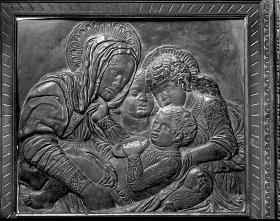
Der Eifer, mit dem einzelne Christen ihren Glauben praktizierten, hat oft auch Spuren an den Werken hinterlassen, die ihnen zur privaten Andacht dienten. Besitzer mögen sie wiederholt geküsst und liebkost haben, wodurch in die Oberfläche geschnitzte Details abgerieben wurden, wie dies bei Hans Peissers Relief der Maria mit Kind der Fall ist. Die Schnitzerei war möglicherweise ein Modell für eine Bronzeplakette. Dennoch ist die Oberfläche stark berieben, als sei das Relief immer wieder berührt worden. Das dezidiert katholische Bildmotiv lässt vermuten, dass es für einen Auftraggeber außerhalb von Nürnberg gefertigt wurde, wo Peisser arbeitete und wo 1525 die Reformation eingeführt wurde. Die Glaubensbewegung veränderte das taktile Verhältnis zu den göttlichen Bildern; die Reformation warf die Frage auf, wo die Grenze zwischen Andacht und Idolatrie anzusetzen sei. Die Unterscheidung zwischen Kunstwerk, Repräsentation und Reliquie scheint sich in diesem Werk aufzulösen. Die Patina des Reliefs zeugt von dem Bedürfnis, mit etwas in Kontakt zu treten, das über das Objekt hinausgeht. (Andrew Sears 2017)
Der sein Blut spendende Erlöser in der Glorie
Skulpturensammlung und Museum für Byzantinische Kunst
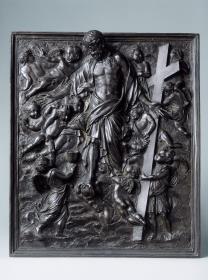
Das Relief zeigt den Erlöser inmitten einer Schar von Engeln, die ihn trägt und begleitet sowie Kreuz und Kelch präsentiert. Durch die ausgelassen bewegten Engelsfiguren besitzt das Relief eine leichte und heitere Komponente und steht damit im Gegensatz zum Bildinhalt. Sansovino variiert ein Thema, das als Andachtsbild vor allem in der oberitalienischen Malerei verbreitet war. Den frühesten Nachweis der Komposition liefert das Spesenbuch des Malers Lorenzo Lotto, der 1542 einen Gipsabguss erwarb, den er vermutlich zusammen mit zwei Statuetten, die Glauben und Häresie darstellten, als Hausaltar aufstellte. Wenig später verwendete Lotto die Komposition in einem 1543 dokumentierten Gemälde ähnlichen Formats, das sich heute im Kunsthistorischen Museum in Wien befindet.
Madonna
Skulpturensammlung und Museum für Byzantinische Kunst
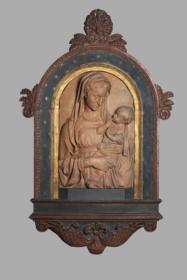
Michelozzo arbeitete eng mit Donatello zusammen und machte später eine erfolgreiche Karriere, sowohl als Bildhauer und als Architekt. Diese Gruppe zeigt das innige Verhältnis zwischen Mutter und Jesus: Die Mutter tröstet ihren Sohn, der Schmerzen durch wachsende Zähne hat. Hinter dieser vertrauten Szene sollte eine Vorausweisung auf das Leiden und den Tod Christi gesehen werden. Michelozzo collaborated closely with Donatello and subsequently pursued a successful career, both as a sculptor and as an architect. This group insists on the intimacy between Mary and Jesus, the mother consoling her son who suffers from teething pain. Behind this familiar scene, one should see a prefiguration of Jesus’ suffering and death.

Sitzende Muttergottes mit Kind
Skulpturensammlung und Museum für Byzantinische Kunst
Die Beherrschung der Bildhauerei in verschiedenen Materialien ist eine technische Herausforderung. Hans Leinberger, ein besonders innovativer Künstler im frühen 16. Jahrhundert, arbeitete hauptsächlich in Holz. Dieses Relief ist ein seltenes Beispiel einer Steinskulptur von seiner Hand.
Macht und Reichtum huldigen Jakob Fugger
Skulpturensammlung und Museum für Byzantinische Kunst
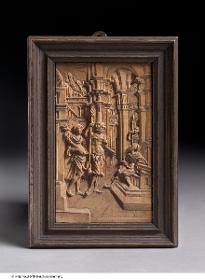
Das Holzrelief ist von miniaturhafter Dimension. Virtuos die Ausführung der reichen, in perspektivischer Verkürzung gestalteten Palastarchitektur, die in den Formen der italienischen Renaissance gestaltet ist. Sie bildet die bühnenhafte Kulisse für vier Personen. Von links herantretend, erweisen eine weibliche Gestalt mit dem Füllhorn des Reichtums und ein Soldat in antikischer Rüstung und Standarte als Sinnbild der Macht einem am rechten Bildrand thronenden Mann, der von einem Wächter hinterfangen wird, ihre Ehrerbietung. Der Thronende ist niemand anderes als Jakob Fugger, um 1520 der reichste und mächtigste Bürger Augsburgs, Haupt der Fuggerschen Handelsgesellschaft, der 1519 die Wahl Karl V. zum Kaiser des römischen Reiches mitfinanzierte. Auf der Stufe ist die Inschrift VIS QUIS – »welche Macht« – zu lesen.
Madonna der Via di Pietra Piana
Skulpturensammlung und Museum für Byzantinische Kunst
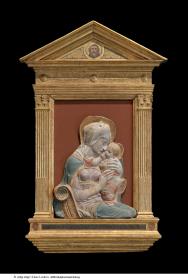
After Donatello? Virgin and Child (called the Madonna di via Pietrapiana) Painted and gilt terracotta 69 x 56 cm (without frame) The frame was not originally with the sculpture; it dates from the mid 15th-century (in the style of Michelozzo according to Schottmüller 1933). Inscription on the base: AVE.MARIA.GRATIA.PLENA.DOMINUS.TECUM. Berlin, Staatliche Museen, Skulpturensammlung, Inv. SKS 2431. Bode-Museum, on view. Provenance Berlin, Skulpturensammlung/Altes Museum (1899-1904); Berlin, Skulpturensammlung/Kaiser-Friedrich-Museum (1904-1939); Berlin, storage (1939-1945); Soviet Union, secret storage (1945/46-1958); East Berlin, Skulpturensammlung/Bode-Museum (1958-1990); Berlin, Skulpturensammlung/Bode-Museum (1990-present). Acquisition Acquired in 1899. Anonymous gift (Prince Liechtenstein?). Restoration 1995 (photograph of the reverse in the restoration files of the Bode-Museum). Other Versions • London, Victoria and Albert Museum, Inv. 7412-1860. Stucco, 84 x 69.5 cm. • Scandicci, Pieve di San Giuliano a Settimo. Terracotta, 70 x 53 cm. • Private collection. Formerly Florence, via Pietrapiana. Terracotta, 84 x 68 cm. • Formerly New York, Dr. Preston P. Satterwhite. Terracotta, 129.5 x 66 cm. • Formerly Pieve di San Giuliano a Settimo. • Formerly Vienna, C. Castiglioni (his sale, Vienna, 1930, n°84). Stucco, 112 x 88 cm (with the frame). Comment The relief in terracotta is limited to the Virgin and Child, their haloes, and the faldstool of the Madonna, all painted with pastel colors; the background of the relief, and the frame in an antique style, with the frieze decorated with cherubs and garlands and the gable with God the father, did not originally belong with the Madonna. The seated Virgin is holding her son tightly in her hands, pressing his body against hers, while her face approaches his. All wrapped in swaddling clothes, Jesus has gotten his right arm loose from his bandages; he brings his fingers to his mouth. This is an intimate vision of a mother and child, in which the foreshadowing of the death of Christ is only apparent in the somewhat absent air of the Madonna. Since its acquisition by the Berlin Museums in 1899 (by anonymous gift; an inventory book in the Bode-Museum mentions Prince Liechtenstein), this work has always been connected with Donatello. Typically Donatellesque are indeed the profile of the Virgin (see Inv. SKS 51), her arm parallel to the relief plane (Inv. SKS 59), the Antique-style faldstool on which she sits, the way she is dressed and her tight hold on the Christ Child (see especially the Virgin and Child in the Musée du Louvre; Inv. RF 353). The mantle of the Virgin is held together on her breast by a fibula with a seraph, as is the case with the Virgin of the High Altar of the church of Sant’Antonio, Padua. However, the quality of the Berlin Madonna is too modest to be more than a replica after a prototype by Donatello. This composition is known in many versions under the name Madonna di via Pietrapiana, from a relief that was long on view in this Florentine street, near Santa Croce (today in a private collection). Long thought to have been a replica after a lost original by Donatello, the latter was proposed after restoration to be an original creation by Donatello (Avery 1985). Some scholars have alternatively attributed the composition to a follower of the artist: Fabriczy 1906 thought of Antonio da Pisa and Venturi 1908 of Francesco del Valente. The question cannot be solved as the oeuvres of these sculptors are still very elusive. Bibliography Fabriczy 1906 C. de Fabriczy, “Antonio di Chellino da Pisa”, L’Arte, IX, 1906, p. 444: the Berlin version is a copy after the original in the via Pietrapiana, Florence, by the Paduan follower of Donatello, Antonio di Chellino da Pisa. Schubring 1907 Paul Schubring, Donatello. Des Meisters Werke in 277 Abbildungen, Stuttgart and Leipzig, Deutsche Verlags-Anstalt, 1907, p. 201: school of Donatello. Venturi 1908 Adolfo Venturi, Storia dell’arte italiana. VI. La scultura del Quattrocento, Milan, Ulrico Hoepli, 1908, p. 452: the composition may be by Francesco del Valente. Schottmüller 1913 Frida Schottmüller, Die italienischen und spanischen Bildwerke der Renaissance und des Barocks in Marmor, Ton, Holz und Stuck, Berlin, Georg Reimer, 1913, p. 20 cat. 42: after Donatello; the composition is Florentine and not Paduan (as argued by Fabriczy 1906). Maclagan and Longhurst 1932 Eric Maclagan and Margaret H. Longhurst, Catalogue of Italian Sculpture, London, Victoria and Albert Museum, 1932, p. 25: workshop of Donatello. Schottmüller 1933 Frida Schottmüller, Die italienischen und spanischen Bildwerke der Renaissance und des Barock. Erster Band. Die Bildwerke in Stein, Holz, Ton und Wachs, Zweite Auflage, Berlin and Leipzig, Walter de Gruyter & Co., 1933, pp. 13-14: workshop of Donatello. Middeldorf 1938 Ulrich Middeldorf, review of Schottmüller 1933, Rivista d’arte, XX, 1938 now in: idem, Raccolta di scritti that is Collected Writings. I. 1924-1938, Florence, SPES, 1979-80, p. 379: compared with the standing Virgin and Child in the Morgan Library, New York. Valentiner 1938 W. R. Valentiner, Catalogue of an Exhibition of Italian Gothic and Early Renaissance Sculpture, exh. cat. (Detroit, The Detroit Institute of Art, 7 January-20 February 1938), Detroit, The Detroit Institute of Art, 1938, cat. 28: related to a work lent in the exhibition by Dr. Preston P. Satterwhite, New York. Avery 1986a Charles Avery in Alan Phipps Darr and Giorgio Bonsanti (eds.), Donatello e i suoi, exh. cat. (Florence, Forte del Belvedere, 15 June-7 September 1986), Detroit and Florence, The Detroit Institute of Arts, La Casa Usher and Arnaldo Mondadori Editore, 1986, p. 154: after Donatello, the original is in via Pietrapiana, Florence. Avery 1986b Charles Avery, “Donatello’s Madonnas Reconsidered”, Apollo, CXXIV, n°295 (new series), September 1986, pp. 181-182: the version in the via Pietrapiana is by Donatello, ca. 1455-1460. Poeschke 1986 Joachim Poeschke, review of Darr and Bonsanti 1986, Kunstchronik, XXXIX, n°12, December 1986, p. 506: the version in the via Pietrapiana is not by Donatello. Pope-Hennessy 1993 John Pope-Hennessy, Donatello Sculptor, New York, London and Paris, Abbeville Press, 1993, p. 344 note 18: the version in the via Pietrapiana is not by Donatello but by an unidentified follower, ca. 1455. Rosenauer 1993 Artur Rosenauer, Donatello, Milan, Electa, 1993, p. 298: the version in the via Pietrapiana is not by Donatello. Jolly 1998 Anna Jolly, Madonnas by Donatello and his Circle, Frankfurt am Main et al., Peter Lang, 1998, pp. 136-139 cat. 37.1: after Donatello, early 1460s; differences between the Berlin version and the one in the via Pietrapiana, Florence. Bormand 2008 Marc Bormand, Donatello. La Vierge et l’Enfant. Deux reliefs en terre cuite, Paris, Musée du Louvre and Somogy, 2008, pp. 16, 49 fig. 25: after Donatello. Neville Rowley (20 May 2016)