


Fotonachweis: Staatliche Museen zu Berlin, Skulpturensammlung und Museum für Byzantinische Kunst / Fotograf*in

Objektbeschreibung
After Donatello?
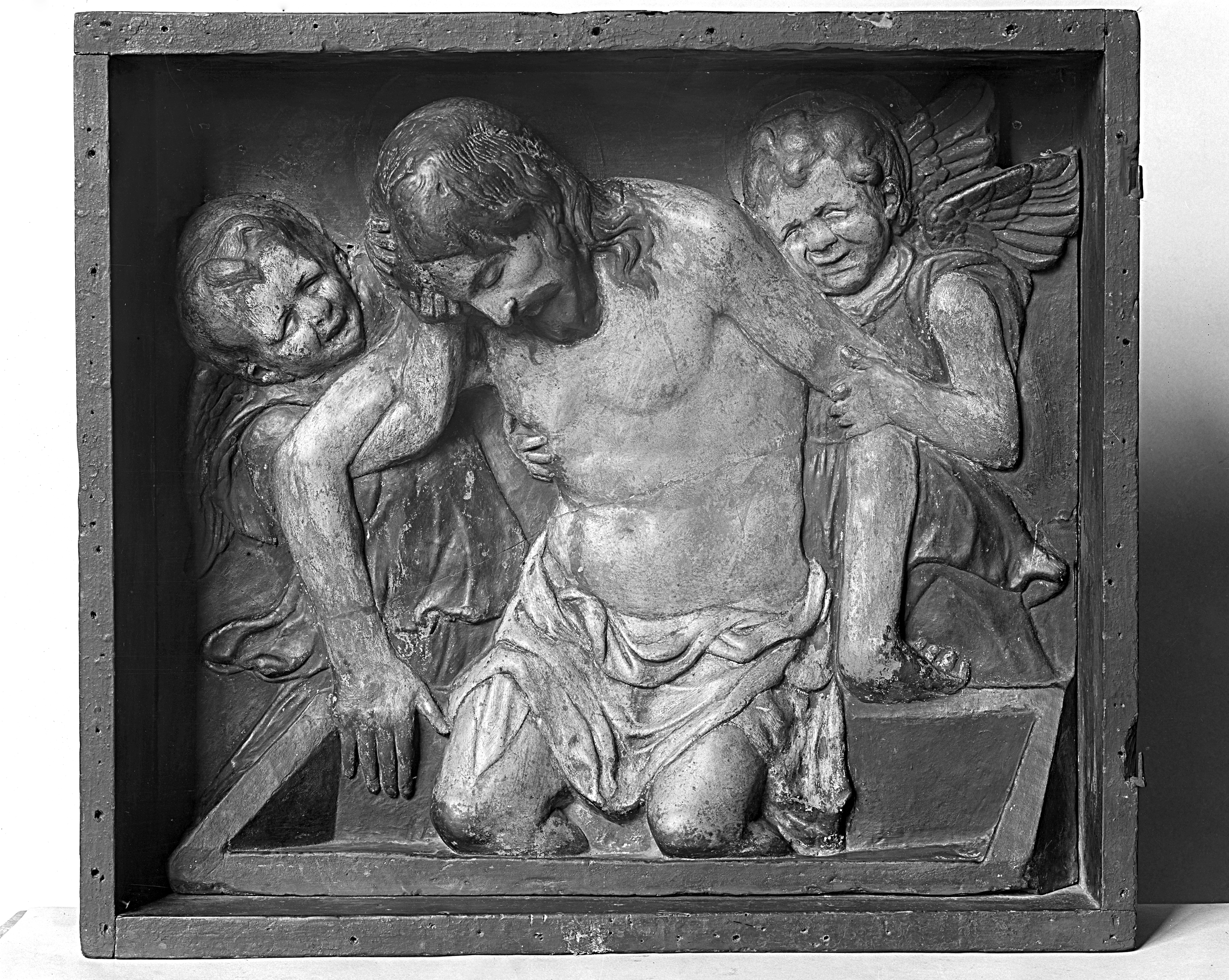
The Dead Christ Tended by two Angels
2nd half of the 15th century
Painted terracotta
47 x 54 cm
Berlin, Staatliche Museen, Inv. SKS 2439.
Formerly Kaiser-Friedrich-Museum, Berlin. Lost since May 1945.
Provenance
Venice (1899); Berlin, Skulpturensammlung/Altes Museum (1899-1904); Berlin, Skulpturensammlung/Kaiser-Friedrich-Museum (1904-39); Berlin, storage (1939-45); whereabouts unknown (1945-present).
Acquisition
Bought in Venice in 1899; Gift. Acquisition file n°2553/99 (Zentralarchiv der Staatlichen Museen zu Berlin).
Other versions
• Faenza, Pinacoteca Comunale di Arte Antica e Moderna, Inv. 204 (the composition has an additional angel). Cartapesta on panel, 84 x 88 cm. Acquired in 1937 through the dealer Monti di Fermo.
• Malatolo, San Lorenzo.
• Padua, Eremitani Church.
• Parma, Galleria Nazionale.
• Princeton, University Art Museum, Inv. 62.75. 45 x 52 cm.
• Washington, National Gallery of Art.
Comment
This work is a symbolic representation of the Dead Christ exhibited to the beholder by two angels. This iconographical type, known as Engelpietà, achieved a great popularity in the late Middle Ages north of the Alps. In Italy, such iconography was especially widespread in the late 15th century in Northern Italy, especially in Venice where it was informed by Byzantine icons. Besides style, this is the main reason why the literature has postulated that the present work could come from Padua and date from the late 15th century, as it is echoed in many works, especially in painting (by Giovanni Bellini or Carlo Crivelli; see also a detached fresco from the Pellegrini Cappella in Sant’Anastasia, Verona). Schottmüller 1913 connected the relief with an altarpiece in the church of the Eremitani then attributed to Giovanni Minelli and dated 1495.
In 1996, Andrea De Marchi noted that such a composition existed earlier in the visual culture of Padua, attributing a Man of Sorrows between two angels in the Museum of Eztergom to Filippo Lippi, documented in Padua in 1436 (see also another painting with the same subject in the Museo Poldi Pezzoli, Milan). According to De Marchi (1996a and 1996b), the proliferation of this motif was a consequence of Donatello’s stay in Padua (1443-1454). Three reliefs with a similar iconography have been linked with the Paduan period of Donatello: a bronze relief in the High Altarpiece of the Basilica del Santo (by a pupil of the master); a marble relief now in the Victoria and Albert Museum (by Donatello); and another marble in the Paduan church of San Gaetano (very close to Donatello, and to a relief published by Bode in the Burlington Magazine in 1926, whose whereabouts are unknown). It is then tempting to think of our lost relief (and its replicas) as a direct derivation of a work by Donatello.
Literature
Schottmüller 1913
Frida Schottmüller, Die italienischen und spanischen Bildwerke der Renaissance und des Barocks in Marmor, Ton, Holz und Stuck, Berlin, Georg Reimer, 1913, p. 111 cat. 271: Giovanni Minelli?; close to Minelli’s terracotta altarpiece in the church of the Eremitani, Padua, dated 1495; the angels are akin to those of the Sarcophagus of St Giustina in the Victoria and Albert Museum, London.
Schottmüller 1933
Frida Schottmüller, Die italienischen und spanischen Bildwerke der Renaissance und des Barock. Erster Band. Die Bildwerke in Stein, Holz, Ton und Wachs, Zweite Auflage, Berlin and Leipzig, Walter de Gruyter & Co., 1933, pp. 102-103: Padua, late 15th-century; close to the “Maestro Giuliano” (formerly identified with Giovanni Minelli).
Casadei 1991
Sauro Casadei, Pinacoteca di Faenza, Bologna, 1991, p. 40 cat. 75: the Faenza version is tentatively ascribed to Bartolomeo Bellano (follows the opinion of Giovanni Fiocco).
Gentilini 1991
Giancarlo Gentilini in Giovanni Romano (ed.), Dal Trecento al Seicento. Le arti a paragone, exh. cat. (Turin, Antichi Maestri Pittori, 2 October-30 November 1991), Turin, Antichi Maestri Pittori, 1991, p. 45: lively naturalism in the style of Giovanni Minelli; replica in the lunette of the San Nicola da Tolentino altarpiece in the church of the Eremitani, Padua, made by Domenico Boccarolo in 1495; with a third angel by a weaker hand.
De Marchi 1996a
Andrea De Marchi, “Centralità di Padova: alcuni esempi di interferenza fra scultura e pittura nell’area adriatica alla metà del Quattrocento”, in Charles Dempsey (ed.), Quattrocento adriatico. Fifteenth-Century Art of the Adriatic Rim, symposium papers (Florence, Villa Spelman, 1994), Bologna, Nuova Alfa Editoriale, 1996, pp. 72-73: groups the work with three other versions (Faenza, Parma, Princeton); usually dated in the late 15th-century but here considered a copy after a lost work by Donatello, also echoed in two works by Filippo Lippi in the Museo Poldi Pezzoli, Milan, and in the Museum of Esztergom.
De Marchi 1996b
Andrea De Marchi, “Un raggio di luce su Filippo Lippi a Padova”, Nuovi Studi, I, 1, 1996, p. 19 note 35; fig. 25: after Donatello.
Markham Schulz 1996
Anne Markham Schulz, “Further Thoughts on Niccolò di Giovanni Fiorentino”, in Charles Dempsey (ed.), Quattrocento adriatico. Fifteenth-Century Art of the Adriatic Rim, symposium papers (Florence, Villa Spelman, 1994), Bologna, Nuova Alfa Editoriale, 1996, p. 152, fig. 5: after Donatello, invented in Florence in the 1430s.
Petrucci 2001
Francesca Petrucci in Roberta Bartoli, Angela Donati and Enrico Gamba, Il potere, le arti, la guerra. Lo splendore dei Malatesta, exh. cat. (Rimini, Castel Sismondo, 3 March-15 June 2001), Milan, Electa, 2001, p. 372: after Donatello.
Tátrai 2003
Vilmos Tátrai in Zsombor Jékely (ed.), Verrocchio’s Christ, exh. cat. (Budapest, Szépmüvészeti Múzeum, 13 March-22 June 2003), Budapest, Szépmüvészeti Múzeum, 2003, pp. 70, 119: link with the Man of Sorrows by Filippo Lippi preserved in the museum of Esztergom; derives from a lost work by Donatello.
Lambacher 2006
Lothar Lambacher (ed.), Staatliche Museen zu Berlin. Dokumentation der Verluste. Skulpturensammlung. Band VII. Skulpturen. Möbel, Berlin, Staatliche Museen zu Berlin-Preußischer Kulturbesitz, 2006, p. 148: last documented in the Tresor der Neue Reichsmünze, Berlin, on 7 April 1945, crate n°132 KFM.
Motture 2006
Peta Motture, “Donatello a Padova: pratica di bottega e scambio artistico”, in Davide Banzato, Alberta De Nicolò Salmazo and Anna Maria Spiazzi (eds.), Mantegna e Padova 1445-1460, exh. cat. (Padua, Musei Civici, 16 September 2006-14 January 2007), Milan, Skira, 2006, p. 115: related to the Man of Sorrows by Donatello in the Victoria and Albert Museum, London (Inv. 7577-1861), and the bronze relief with the same subject from the High Altar of the Santo, Padua.
De Marchi 2008
Andrea De Marchi, “Ancona, porta della cultura adriatica. Una linea pittorica, da Andrea de’ Bruni a Nicola di maestro Antonio”, in idem and Matteo Mazzalupi, Pittori ad Ancona nel Quattrocento, Milan, Federico Motta Editore, 2008, pp. 83-85: after Donatello; echoed by Carlo Crivelli in the polyptych of Montefiore sull’Asso (now in the National Gallery, London) and Lorenzo d’Alessandro in the late 1480s in the polyptych in San Francesco, Serrapetrona.
Kupiec 2011
Catherine Kupiec in Catherine Puglisi and William Barcham (eds.), Passion in Venice. Crivelli, Tintoretto and Veronese. The Man of Sorrows in Venetian Art, exh. cat. (New York, Museum of Biblical Art, 11 February-12 June 2011), New York and London, Museum of Biblical Art and D Giles, 2011, p. 72: after Donatello.
Pistocchi 2012
Michele Andra Pistocchi in Marco Bona Castellotti and Massimo Pulini (eds.), Gli angeli della Pietà. Intorno a Giovanni Bellini, exh. cat. (Rimini, Museo della Città, 19 August-4 November 2012), Turin et al., Umberto Allemandi, 2012, pp. 35-36: the Faenza version is attributed to Bartolomeo Bellano, 1460-80; mentions the Berlin version p. 35 (but not that it has been lost); relates it to the bronze Man of Sorrows made by Bellano for the High Altar of the Santo, Padua; descends from the Man of Sorrows by Giovanni Bellini at the Museo Correr, but also the one in the St Vincent Ferrer Polyptych in the church of the Santi Giovanni e Paulo, Venice, also by Bellini; the face of the forshortened angel in the Faenza version is reminiscent of the Dead Christ by Andrea Mantegna in the Pinacoteca di Brera, Milan; the Pala di Montalto by Carlo Crivelli and the one in Serrapetona indicate that the relief originates from the Marche region.
Motture 2013
Peta Motture, “Looking Afresh: Reviewing Italian Renaissance Sculpture for the V&A’s Medieval & Renaissance Galleries”, in eadem, Emma Jones and Dimitrios Zikos (eds.), Carvings, Casts & Collectors. The Art of Renaissance Sculpture, symposium papers (London, Victoria and Albert Museum, 12-13 November 2010), London, V&A Publication, 2013, pp. 25-26: after Donatello?; only mentions the Princeton version in comparison to the Man of Sorrows in the Victoria and Albert Museum, London, no longer believed to be by Donatello but created ca. 1530.
Neville Rowley (24 May 2016)